
KES Drag & Gripstrumpor AB
KES hand-braids pulling and support grips for cable, wire rope, hose and pipe, and the first grip was braided in 1969. The company got a new site in Swedish and English where the sizes for every model are one click away, plus a Facebook page and an Instagram account of its own. See the site in five views below.
Visit the site live ↗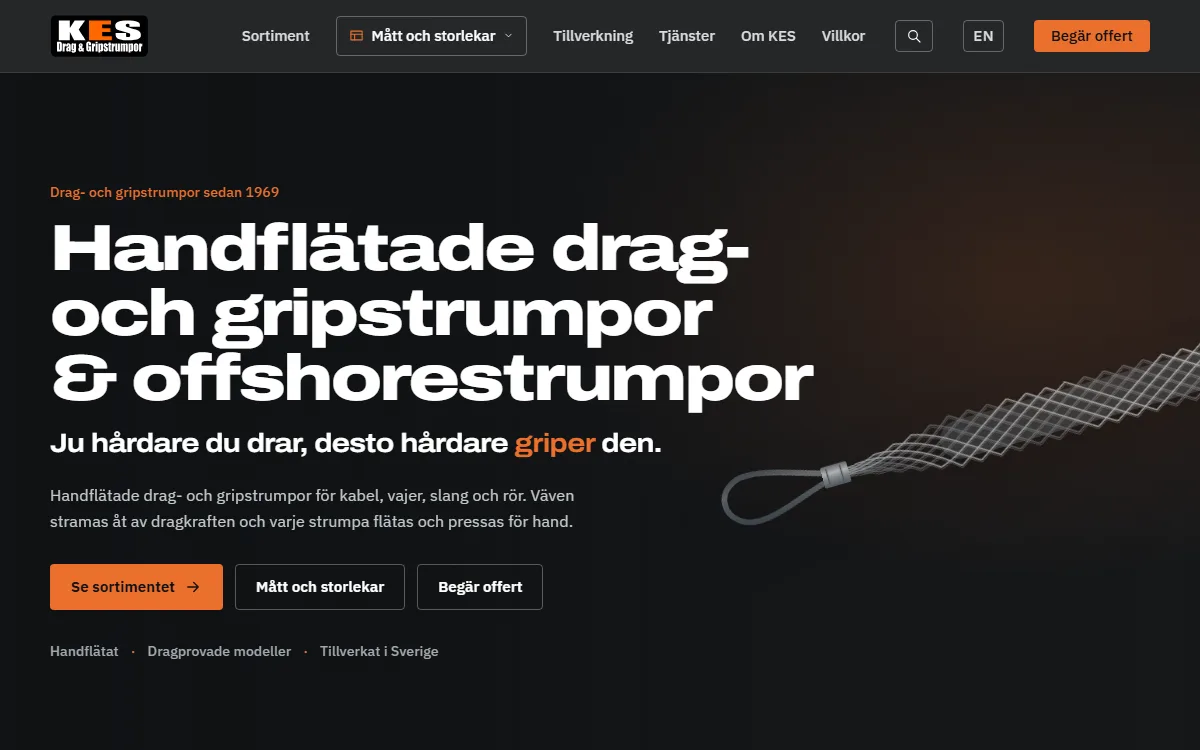
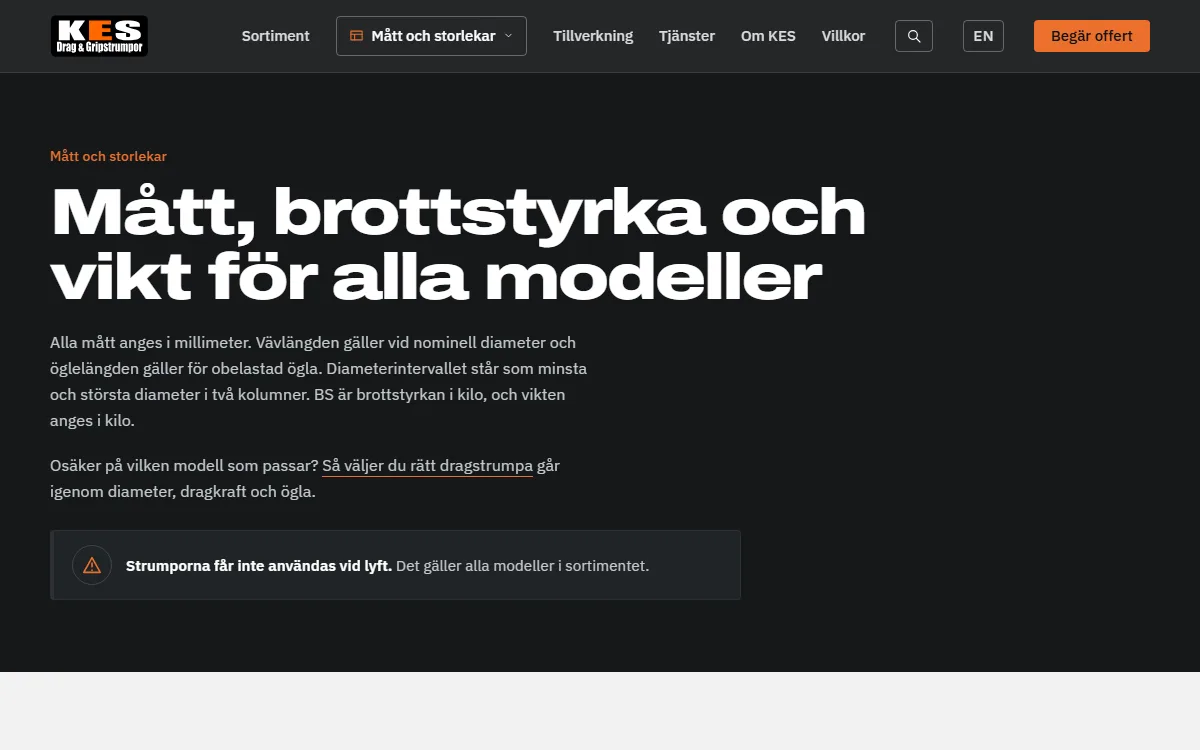
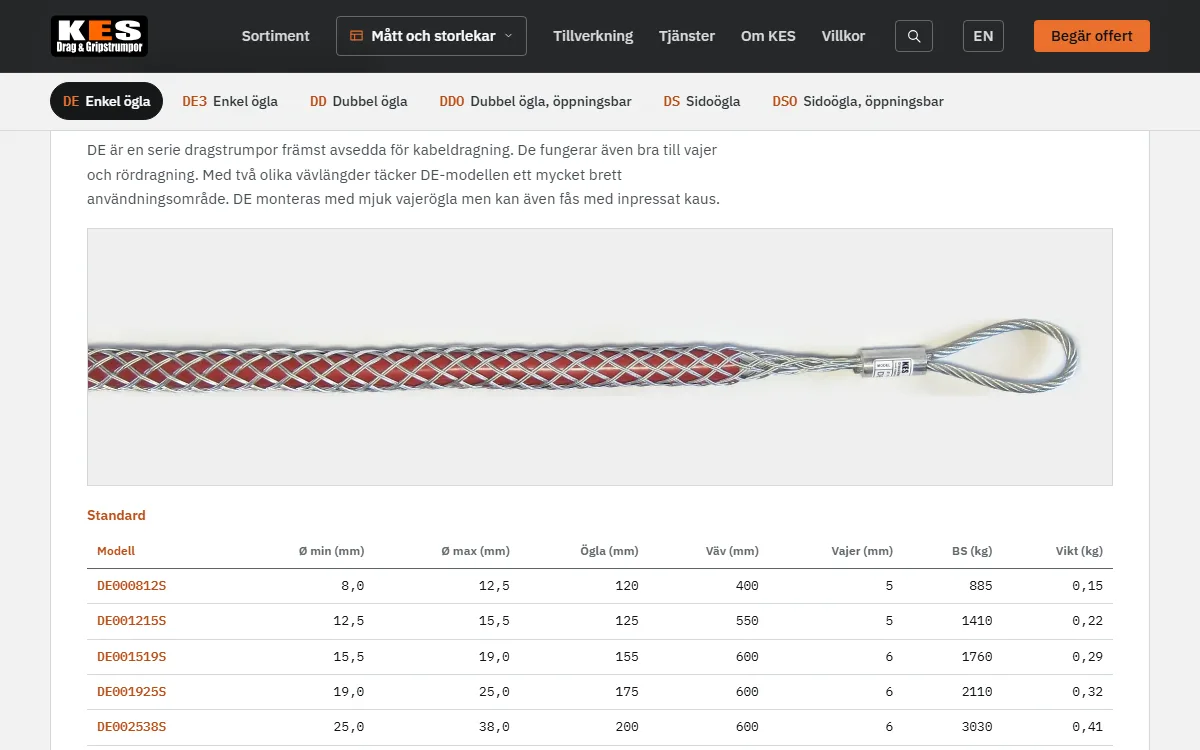
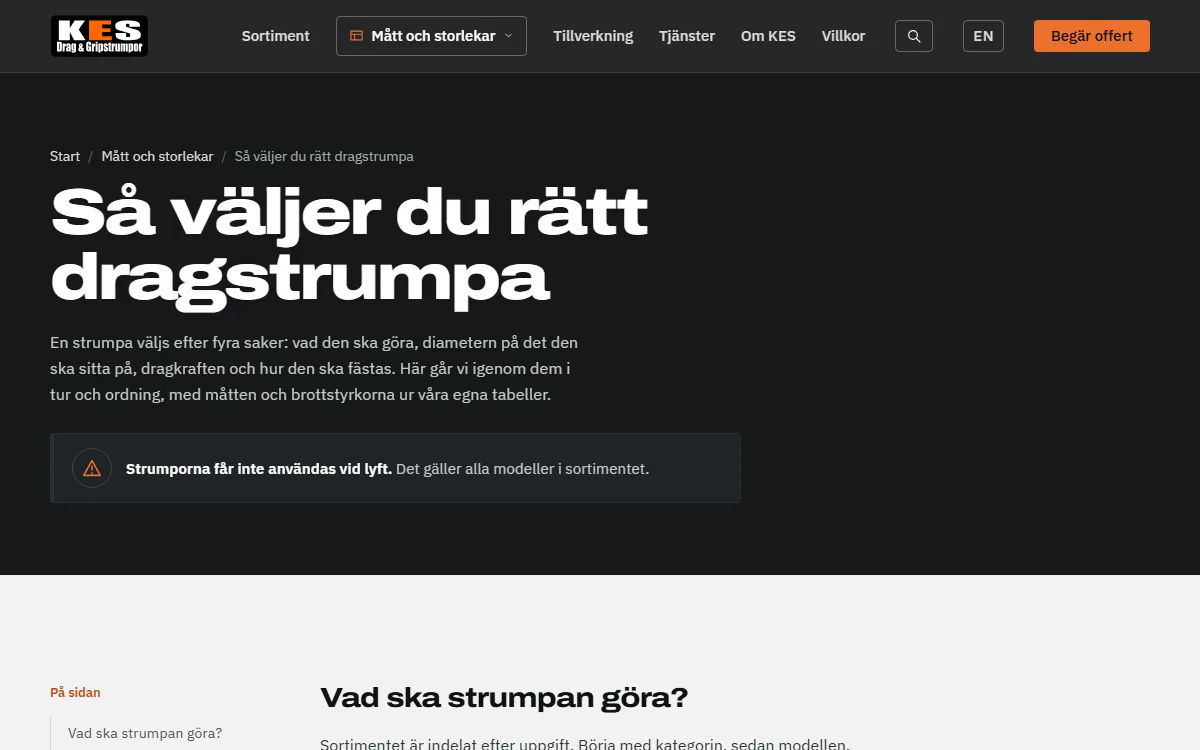
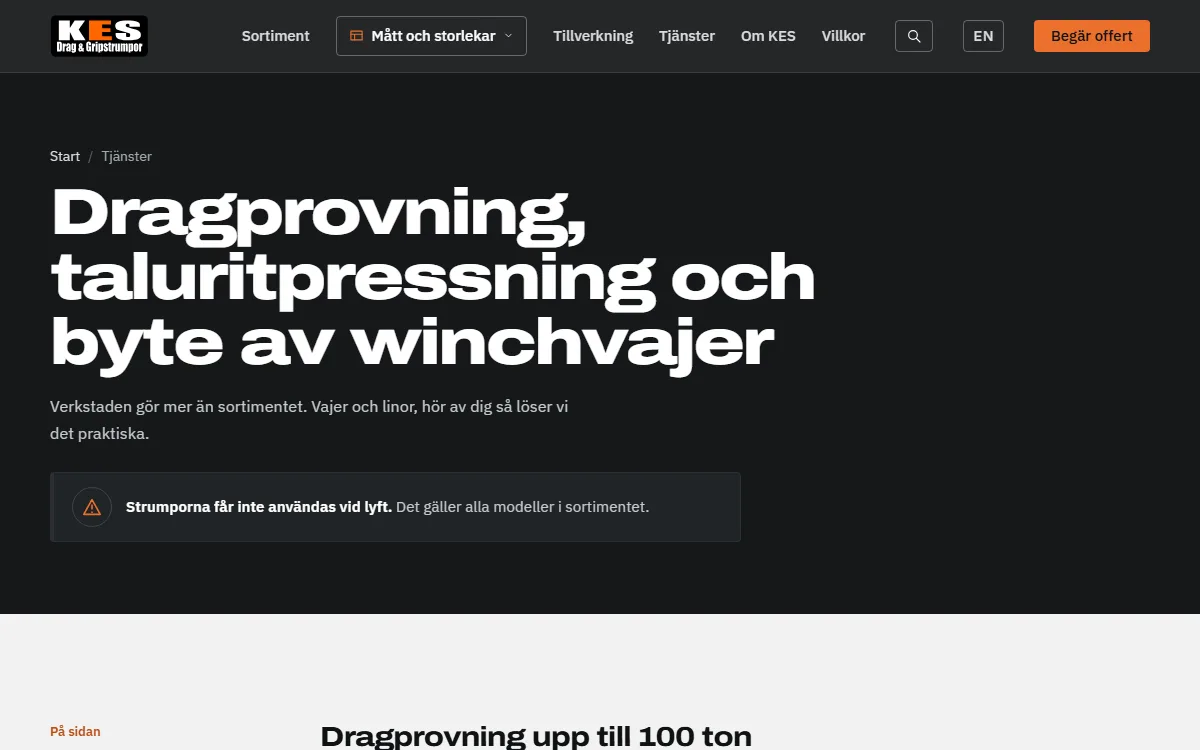
The site in five views. Click a view to visit it live.
What I did
Rebuilt the site from scratch
Twenty-eight pages in Swedish and English: the home page, an overview and nine category pages with the sizes, the selection guide, the services page and a confirmation page in each language. Static HTML with no framework, and the size pages are written by a script from a single table file, so a size in the tables only ever changes in one place.
Size tables for 25 models
Every table from the old site was moved across model by model: diameter, mesh, eye, wire, breaking strength and weight for every article number, in the client's own order. Where the client corrected a breaking strength, the client's figure took precedence over the old site's.
The size guide one click away
The Dimensions and sizes menu item opens a panel with all nine categories on every page, so the buyer reaches the right table without going via the home page. Without JavaScript it is an ordinary link to the overview.
A search box for sizes and article numbers
The search box in the menu finds categories, models and article numbers. If the buyer types a diameter, such as 25, it lists the models that fit a 25 mm cable.
A guide to choosing the right grip
The guide on choosing the right pulling grip walks through category, size, breaking strength and eye, using the client's own information. The example and the selection table are calculated from the same tables as the size pages.
The services and the film from the test bench
A page of its own for tensile testing up to 100 tonnes, Talurit swaging, winch rope replacement and special models. The client's film from the test bench sits there and on the home page, and it only starts when the visitor presses play.
A check script that stops errors
Before every release a check script goes through every page. It stops broken forms, menus that have drifted apart and text that breaks the client's own rules.
A quote form on 26 pages
The form is on every page except the confirmation pages and sends along which page, category and model the enquiry is about. It lands in the company's order inbox, and the sender gets an automatic reply in their own language.
Facebook, Instagram and the posts
Created the Facebook page and the Instagram account with profile picture, cover, bio and highlights, and linked them from the site's footer. The first round of posts goes out three times a week on both channels.
What happened
Before
A WordPress site in Swedish with a separate page for each of the 25 models. The sizes were there, but buyers had to click from model to model to compare them.
The choice
Rebuild everything but keep what the client already had: the tables, the order and the texts. The sizes were gathered by category, so the models sit side by side, and the site got an English version. The old addresses forward to the matching page on the new site, including the ones the QR codes on the client's product labels lead to.
After
Live on the client's own domain since 13 October 2026: twenty-six pages in two languages that Google can index, nine categories, 25 models and a route to the right table from every page. The five pages I measured in Lighthouse the same day scored 100 for accessibility, best practices and SEO on mobile and desktop, and 96 to 99 for performance on desktop.
Three choices behind the site
Headings that echo the logo
The headings are set in Archivo in an expanded cut, echoing the stretched capitals of the logo. Body text is IBM Plex Sans, and the monospace face appears only where it carries information: model codes, table data and the company registration number.
Sizes first
Someone buying a pulling grip is looking for the right size. So the sizes can be reached from the menu, the hero, the footer and every category card, and the warning that the grips must not be used for lifting sits next to every model.
Letting the mesh show
The product photos sit on the same light grey background at the same scale, so the mesh reads equally clearly in every product photo. No hard cut-outs: the mesh is see-through, and the background is meant to show through it.
We're really happy with the result.KES Drag & Gripstrumpor AB · translated from Swedish
Why the site looks the way it does
Someone buying pulling grips is looking for a product in a particular size. So every category has a page of its own with its tables, and the quote form sits on the same page as the model. When a domain moves, indexing decides how quickly Google finds the new pages, and you can check whether your own site can be found on Google. I've written more about those parts over in Insights.
Why Google indexing decides whether customers find you
If your page is not indexed it does not exist to customers. How indexing works, why more pages give broader exposure, and how you get into Google.
Read more → EnquiriesFrom form to inbox: what should happen when someone sends an enquiry
An enquiry from your website is a customer waiting for a reply. The flow that gets you the email at once, answers the customer and lets nothing slip.
Read more → AdsSEO, Google Ads and Meta: why the combo beats either-or
Indexed pages (SEO), Google Ads and Facebook/Meta ads are not either-or. How the channels reinforce each other and cover the whole customer funnel.
Read more →Do you sell products customers need to find in the right size?
Do you have a range with sizes, models or article numbers? Get in touch and I'll tell you what I did for KES and what it could mean for you.